Schema Markup: Which Types Are Actually Worth Implementing
Google retired FAQ rich results in May 2026 with no blog post. Here is what still earns a search feature, what only describes a page, and why both matter.
Caliency
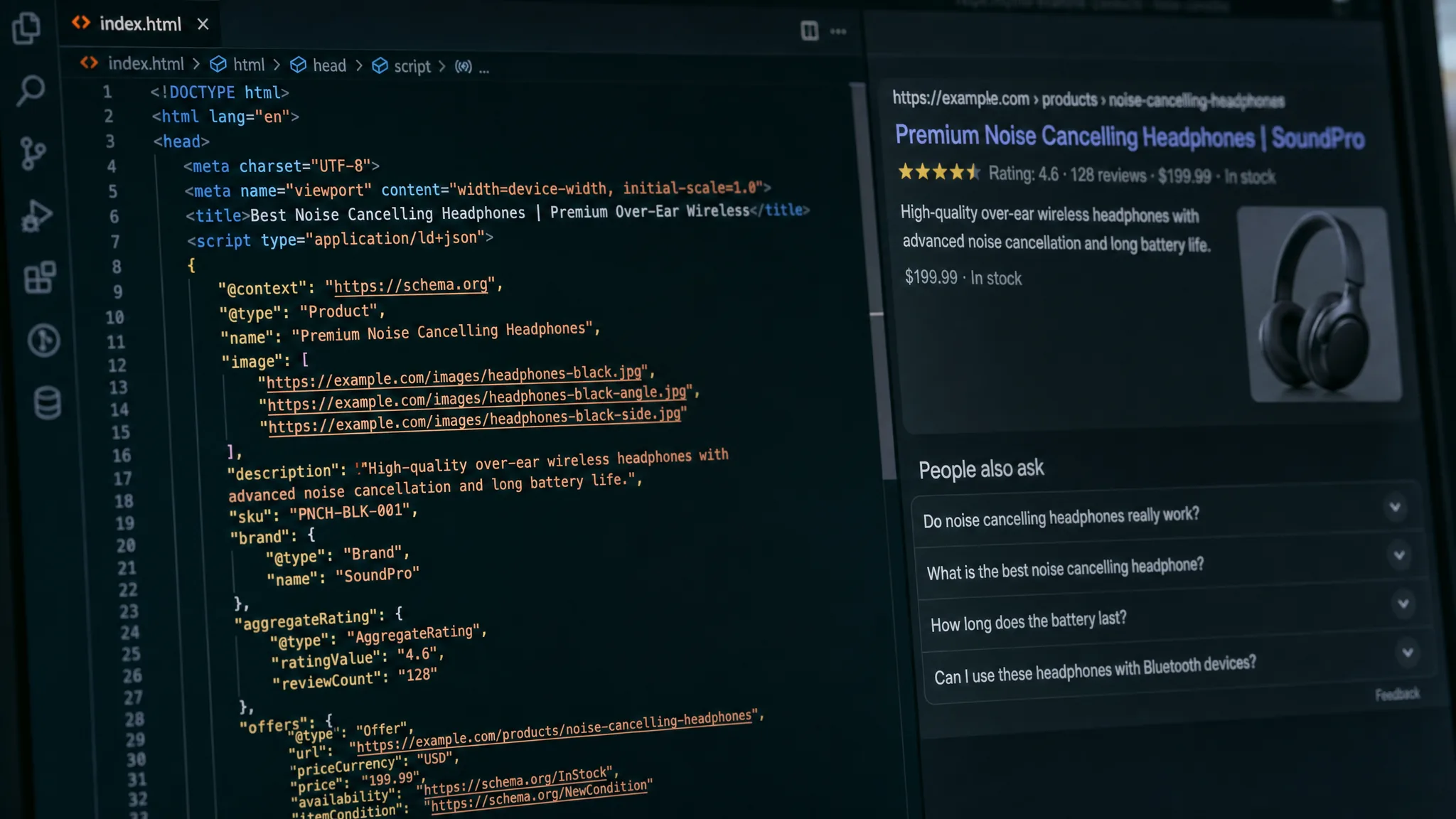
Structured data is machine-readable description added to a page — normally JSON-LD in the head — that tells a search engine what the page is rather than leaving it to be inferred from the prose.
Google's own description is careful: "Google uses structured data to understand the content on the page and show that content in a richer appearance in search results, which is called a rich result" (Google Search Central). Note what it does not promise. Nowhere does the documentation guarantee that adding markup produces a feature.
That gap between what it does and what it is sold as is the subject of this guide — and it got wider in May 2026.
Key Takeaways
- Google retired FAQ rich results in May 2026 and removed the implementation docs in June (Google).
- Structured data does not guarantee a rich result and has never been described by Google as a ranking factor.
- Two different jobs get called "schema": types that earn a visible feature, and types that describe your identity. Both are worth doing; only one shows up in a screenshot.
- The list worth implementing is short: Organization, Article, BreadcrumbList, plus whichever type your page genuinely is. Which Organization properties are worth filling in is a separate question.
- Markup that does not match what the user sees is a policy problem, not a missed opportunity.
What changed in May 2026
If you implemented FAQ schema because an agency told you it would win you more space in the results, that space is gone.
Google's FAQ documentation now states: "The FAQ rich result feature is no longer shown in Google Search results, as announced in the changelog entry in May 2026." The page was last updated on 15 June 2026, by which point the implementation guidance had been removed entirely (Google Search Central).
There was no blog post. A banner appeared on a documentation page, and a feature that thousands of sites had built content around stopped existing.
Two things are worth separating here.
The rich result is gone. No expandable questions under your result, no extra vertical space, no reason to write FAQ sections in order to earn one.
The vocabulary is not. FAQPage is still valid schema.org. It still accurately describes a page that contains questions and answers. What it no longer does is produce a Google feature — so it belongs in the category of markup you ship because it is true, not because it pays.
This site carries FAQPage markup on several pages and we have left it in place, for exactly that reason: the pages genuinely are question-and-answer content, and describing them accurately costs nothing. What changed is that we no longer count it as an SEO deliverable, and neither should anyone quoting you for it.
FAQ is not the first. HowTo rich results were deprecated on desktop back in 2023, and Google retired a further batch of types in 2025. The pattern is clear enough to plan around: the set of features is not stable, so do not build a content strategy whose value depends on one surviving. How widely markup for retired features lingers on popular sites, we measured in what is answer engine optimization.
Two jobs that both get called "schema"
Most confusion in this area comes from treating these as one thing.
Feature markup earns a visible change to your search result. Product with price and availability, Review snippet with a star rating, Event with dates, Recipe with a cook time, JobPosting, LocalBusiness. If the type matches your page, this is worth doing — it changes how much of the results page you occupy and how much a searcher knows before clicking.
Identity markup produces nothing visible and is still worth doing. Organization says who publishes this site. BreadcrumbList describes where a page sits in a hierarchy. Article or BlogPosting says this is an article, by whom, published when. None of it draws a star. All of it makes the page unambiguous to a machine that is deciding what your page is about.
The second category matters more than it used to, and for a reason that has nothing to do with Google's results page: systems that assemble answers rather than lists benefit from unambiguous machine-readable identity. Our GEO guide is honest about how weak the evidence is for most AI-visibility tactics — but schema is cheap, standards-based, and does not depend on a feature that can be retired.
The short list
Google currently documents 33 structured data types. Almost no site should implement more than four or five.
Everyone:
Organization— once, sitewide. Name, logo, contact point, social profiles.BreadcrumbList— anywhere a page sits inside a hierarchy.
Anyone publishing content:
ArticleorBlogPosting— headline, author, dates, image.
Then exactly one more, matching what the page actually is:
- Selling physical products →
ProductwithOffer - A location customers visit →
LocalBusiness - Selling software →
SoftwareApplication - Running events →
Event - Hiring →
JobPosting
That is the whole list for most businesses. If a proposal includes eight types for a five-page site, it is billing for volume rather than effect.
Where this goes wrong
Marking up something the user cannot see. This is the serious one. If your markup claims a 4.8 star rating and the page shows no reviews, or a price that is not the price on the page, that is a mismatch between your markup and your content — and it can cost you rich results across the whole site, not just on that page.
Implementing a type that does not apply. Product markup on a service page. Review markup on your own testimonials page describing yourself. These do not fail loudly; they simply never render, and everyone assumes it is working.
Assuming eligible means shown. The Rich Results Test tells you a page is eligible. Whether the feature appears is Google's decision, per query, and it changes. A green test result is a necessary condition, not an outcome.
Letting it drift. Markup is written once and then the page changes around it. Prices move, authors leave, the breadcrumb structure gets reorganised. Stale structured data is worse than none, because it is a confident machine-readable statement that is now false.
How to check it
Two tools answer two different questions, and using the wrong one is why teams believe markup is working when it is not.
Rich Results Test — for a page you have just changed. It answers "is this page eligible for this feature right now".
Search Console's rich result reports — for the site over time. It answers "what did Google actually see, and did anything break after the last deploy". This is the one that catches drift, and the one people forget exists.
If you want the layer underneath this — indexing, crawlability, the things that decide whether markup gets read at all — what SEO actually consists of covers the foundation, and our SEO service treats structured data as hygiene rather than as a headline deliverable.
In short
Implement Organization, BreadcrumbList, Article, and the one type your page genuinely is. Ship anything else only if it describes something a visitor can actually see. Do not build content around a rich result, because features get retired — May 2026 removed one that a great many sites had organised entire pages around, with a documentation banner and no announcement.
And if someone quotes you for FAQ schema as an SEO deliverable in 2026, they have not read the documentation this year. We will tell you what is actually worth doing — including when the answer is "less than you were quoted for".
Got a project in mind?
We'll scope it and give you a fixed price on one call.
Keep reading
SEO in 2026: The Complete Guide for Businesses
What SEO covers, the three layers it is built from, how long it really takes, and how AI summaries changed click behaviour. Written to help you decide.
→SEOTechnical SEO Checklist: What 200 Sites Get Wrong
A technical SEO audit of 200 popular Turkish sites: one in five tells search engines that a page which doesn't exist loaded fine. The checklist inside.
→