Google AI Overviews: How to Appear and How to Measure It
Google says no special markup is needed. Search Console now reports AI visibility — impressions only, no clicks. What that combination means.
Caliency
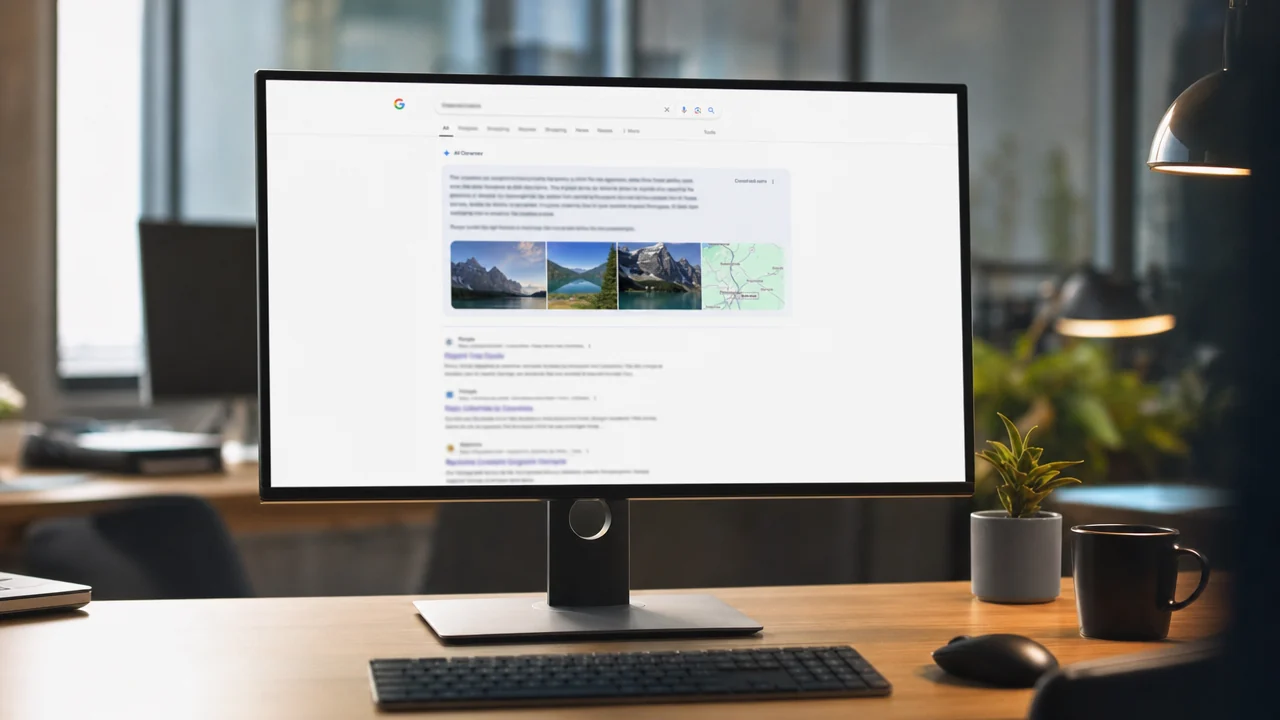
There are two honest answers here, and both are shorter than the articles selling you AI Overview strategies.
How to appear: be eligible for Google Search in the ordinary way. Google's own documentation is explicit that nothing else is required.
How to measure it: Search Console will now tell you how often you appeared — and nothing else at all.
The interesting part is what those two facts mean together, which is the subject of this guide.
Key Takeaways
- "There are no additional requirements to appear in AI Overviews or AI Mode, nor other special optimizations necessary" (Google).
- Search Console's generative AI report covers AI Overviews and AI Mode — impressions only. No clicks, no CTR, no position (Google).
- Users clicked a link inside an AI summary on 1% of visits (Pew Research Center).
- Ranking does not predict citation: 53% of AI-Overview-cited domains were absent from the organic top 10 (Martinez, arXiv).
- So the measurement you can get and the outcome you care about are not the same number, and no tool closes that gap today.
How to appear: the short version
Google's page on AI features in Search says three things that settle most of the debate:
"There are no additional requirements to appear in AI Overviews or AI Mode, nor other special optimizations necessary."
"You don't need to create new machine readable files, AI text files, or markup to appear in these features."
"To be eligible to be shown as a supporting link in AI Overviews or AI Mode, a page must be indexed and eligible to be shown in Google Search with a snippet, fulfilling the Search technical requirements. There are no additional technical requirements."
(Google Search Central, last updated 10 December 2025.)
Read the third one carefully, because it contains the only real technical lever: eligible to be shown with a snippet. If you have suppressed snippets — with nosnippet, an aggressive max-snippet limit, or data-nosnippet wrapped around your actual content — you have also made yourself ineligible to be a supporting link. That is the single most common way sites accidentally exclude themselves, and it does not look like an AI setting.
Everything else in this area is ordinary technical SEO: indexed, crawlable, server-rendered, fast enough to fetch. Our SEO service treats it as the same foundation for the same reason.
How to measure it: what Google now gives you
Until recently the honest answer to "are we in AI Overviews?" was "check by hand and hope". That changed in 2026.
Search Console now includes a generative AI performance report showing "how your site performs in generative AI features on Google Search", covering impressions in AI Overviews and AI Mode (Search Console Help).
What it reports:
"Impressions are how many times links to your site were shown to a user in a generative AI feature on Google Search."
What it does not report: clicks, click-through rate, and position. None of them.
Also worth knowing before you build a dashboard on it:
- Recent data is preliminary, may be incomplete, and can change within hours.
- Tables are limited to 1,000 rows.
- Chart totals and table totals can differ because they aggregate differently.
- Sites without enough impressions do not get the report at all.
This is a real improvement over guessing. It is also a very specific kind of visibility: you can now see that you were shown, by page, country and device, over time.
What the two facts mean together
You can measure impressions and you cannot measure what they produced, and that gap is what should decide whether to spend money here — what the analytics do and do not expose draws the same line from the other side.
You can measure impressions. You cannot measure what they produced. And the outside evidence on what they produce is not encouraging as a traffic story.
The Pew Research Center instrumented 900 consenting U.S. adults through March 2025 across 68,879 Google searches, 12,593 of which produced an AI summary. Users clicked a traditional result on 8% of visits where a summary appeared, against 15% where none did — and clicked a source inside the summary on 1% of visits (Pew Research Center).
So: impressions are measurable, clicks are roughly 1%, and Search Console will not tell you even that.
The conclusion we draw — and we would rather say it plainly than sell around it — is that AI Overview presence is a brand outcome, not a traffic outcome. Its value is being the source an answer is built from, in front of someone who is not going to click anything. If your business case for this work requires sessions, the numbers do not support it. If your business case is being the firm that gets named when someone asks the question, they do.
Ranking is not a proxy for it
A tempting shortcut is to assume that if you rank well you will be cited. The evidence says otherwise.
In a 2026 study collected in the field's critical survey, 53% of the domains cited by Google's AI Overviews did not appear in the organic top 10 for the same query, and 27% did not appear in the top 100 at all (Martinez, arXiv).
Practically: your ranking report is not an AI visibility report, and the new Search Console report is not a ranking report. They are two measurements of the same page, and you need both. Our GEO guide goes through what the research does and does not support in more detail — including how little of the popular tactical advice replicates.
A workable programme
Confirm you are eligible. Indexed, crawlable, and — the one people miss — not suppressing snippets. Check for nosnippet, max-snippet, and data-nosnippet wrapped around content you actually want quoted.
Turn on the report and take a baseline. Impressions by page, before you change anything. Without a baseline the report tells you a number rather than a direction.
Write answers that survive extraction. A generative answer lifts a passage out of its context. If your claim is only true with a caveat that sits two paragraphs away, it will be quoted without the caveat. Put the qualification in the same sentence.
Judge it on impressions and brand, not sessions. You are not going to be able to attribute revenue to this, because the tooling does not expose the clicks and the clicks are 1% anyway. Decide before you start what would count as success.
Re-check quarterly rather than daily. Preliminary data changes within hours. Reading it daily is reading noise.
In short
Appearing requires nothing special — being properly indexed and snippet-eligible is the whole technical requirement, and Google says so directly. Measuring it is now possible and deliberately limited: impressions, and nothing downstream of them.
Do the work if being the cited source is worth something to you on its own. Do not do it expecting traffic, because the one large public study of the behaviour puts the click rate at 1%.
If you want someone to check whether your site is even eligible before you think about strategy, that is a short conversation — and it is often the only thing that needs fixing. The site-level setting that governs eligibility, and what the report does not give you, are covered in GEO vs SEO.
Got a project in mind?
We'll scope it and give you a fixed price on one call.
Keep reading
AI Crawlers: Should You Allow Them or Block Them?
GPTBot, ClaudeBot and PerplexityBot are not one decision. Each company runs separate bots for training, search and user requests — and advice conflates them.
→GEOGenerative Engine Optimization (GEO): The Complete Guide
What GEO is, what the research actually shows, which tactics replicate and which do not, and how to measure something that answers differently each time.
→